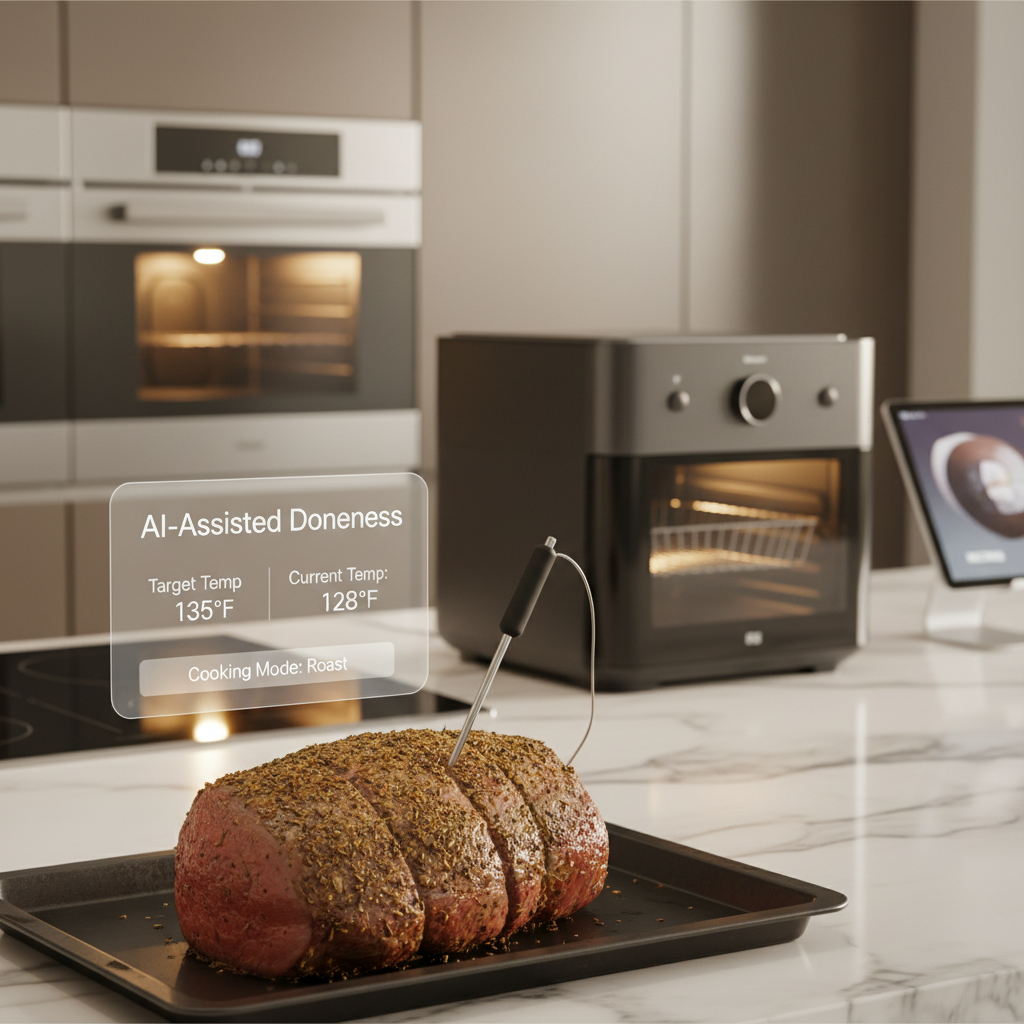
AI-Powered Smart Cooking Appliances: Ovens, Ranges & Air Fryers
AI smart kitchen cooking is not about flashy gadgets; it is about using sensors, automation, and assistants like Alexa or Google to actually make dinner easier and more reliable. The most helpful features quietly handle things you would normally stress over—like hitting the right internal temperature, timing every component, and keeping an eye on your food—so you can focus less on the oven and more on the people you are cooking for.
Affiliate Disclosure: This page contains affiliate links. If you buy through our links, we may earn a commission at no extra cost to you.
Table of contents
- AI-Powered Smart Cooking Appliances: Ovens, Ranges & Air Fryers
- Best smart cooking features that actually improve results
- Sensors That Matter
- Alexa/Google routines for cooking
- Top Brands Overview
- Buying checklist
- Best countertop smart ovens
- Best smart thermometers
- AI Smart Kitchen Cooking Frequently Asked Questions
- Next steps
Best smart cooking features that actually improve results
AI Smart Kitchen Cooking
Not all “smart oven” features change outcomes. So, focus on the functions that measurably improve consistency, timing, and control.
Features that typically do improve results 🎯
- Probe-based cooking (food thermometer integration) 🌡️
- Lets you cook to internal temperature (e.g., chicken, steak, roasts).
- As a result, you rely less on guesswork and more on doneness targets.
- Guided cooking / assisted programs 🧠
- Step-by-step modes that recommend time/temperature and prompt next steps.
- Therefore, it’s especially helpful for less experienced cooks or busy weeknights.
- Accurate preheat + stage alerts ⏱️
- Clear notifications when preheat is done, when to flip, and when food reaches target temp.
- Consequently, you can leave the kitchen without forgetting what’s happening.
- Better temperature stability (control algorithms) ♨️
- Some ovens manage heat more precisely and reduce overshoot/undershoot.
- In other words, you get fewer “burnt edges, undercooked middle” surprises.
- Useful remote monitoring (not just remote control) 📲
- Status checks and alerts are more valuable than starting the oven remotely.
- Plus, monitoring is often safer than remote-start behavior.
Features that are often “nice-to-have,” not must-have 🤷
- Recipe libraries inside the app (helpful, but you may not use them long-term)
- Overly complex “AI modes” that don’t explain what’s being changed
- Too many notifications (they become noise unless you tune them)
Quick rule: buy outcomes, not labels 🧾
- Look for: probe support + reliable alerts + stable cooking performance.
- Be cautious with: vague claims like “AI taste” or “smart cooking magic” without sensor details.
Sensors That Matter
AI Smart Kitchen Cooking
Smart cooking gets “smarter” through sensors. Because sensors provide real data, they’re usually the difference between meaningful automation and marketing.
1) Temperature probes (most important) 🥩
- What it is: A probe measures internal food temperature while cooking.
- Why it matters: internal temp is the most reliable doneness indicator for proteins and baked goods.
- What to look for:
- Probe included vs. optional accessory
- Clear target-temp workflow (set target → alert → optional hold/warm)
- Easy cleaning and safe storage
2) Oven temperature sensing + control stability ♨️
- What it is: internal sensors help maintain set temperature more consistently.
- Why it matters: stability affects browning, baking accuracy, and timing.
- Tip: if you bake often, prioritize ovens known for consistent performance (and consider verifying with an oven thermometer).
3) “Temperature mapping” / multi-point sensing (varies) 🗺️
- What it is: systems that attempt to understand hot/cool spots and adjust behavior.
- Reality check: improvements can be real, but they vary widely by model and installation.
- So, treat it as a bonus—probe cooking usually delivers the bigger win.
4) Humidity/steam awareness (select ovens/cookers) 💧
- What it is: humidity sensors or steam features can help manage moisture for texture.
- Why it matters: can improve bread crusts, reheating quality, and dryness control.
- However: it’s most valuable if you’ll actually cook foods that benefit from humidity control.
5) Air fryer / countertop cooker sensors (common, simpler) 🍟
- What it is: basic temp sensors, timers, and program logic.
- Why it matters: countertop devices often benefit from tighter, smaller cooking chambers; smart features mostly improve convenience (timing and reminders).
- Therefore: don’t overpay for “AI air fryer” claims—prioritize ease of use and repeatability.
Computer vision in cooking (rare, often overhyped) 👁️⚖️
- Vision-based doneness detection sounds great; however, it’s still inconsistent in typical home conditions (lighting, food placement, steam).
- Bottom line: today, probes + stable temp control generally beat “camera intelligence” for reliable doneness.
Alexa/Google routines for cooking
AI Smart Kitchen Cooking
Voice assistants don’t make your oven cook better—but they can make cooking feel smoother and safer. In practice, the best routines reduce friction: hands-free timers, ventilation control, and fewer forgotten steps.
High-utility routines to set up ✅
- “Cooking Mode” routine 🔥
- Trigger: “Alexa, start cooking mode” / “Hey Google, cooking mode”
- Actions (example):
- Turn on under-cabinet/task lights
- Start vent hood (or a smart fan/air purifier)
- Start a named timer (“preheat”)
- As a result: your kitchen environment supports cooking automatically.
- Hands-free multi-timer workflow ⏱️
- Use named timers: “pasta,” “oven,” “resting,” “cookies.”
- Then: ask “How much time is left on pasta?” without touching your phone.
- Ventilation trigger (semi-automated) 💨
- If your hood isn’t smart, use alternatives:
- Smart plug for a countertop fan
- Smart switch for certain compatible fans/lights
- Meanwhile: you can still use voice control to avoid greasy-hand interactions.
- If your hood isn’t smart, use alternatives:
- “Dinner’s ready” broadcast/announcement 📣
- Great for families and open floor plans.
- Consequently: fewer shouted updates, more consistent routines.
Safety notes (important) 🛡️
- Prefer monitoring + alerts over remote starting heating appliances.
- If you enable remote control, use it thoughtfully (e.g., preheat only while you’re home).
- Additionally: keep confirmations enabled where available to prevent accidental triggers.
Top Brands Overview
AI Smart Kitchen Cooking
Brand “smart” platforms change frequently, but their patterns are fairly consistent. So, use this section to match your expectations to the brand’s typical strengths.
GE (including Café/other GE lines) 🍽️
- Often strong for: mainstream availability in the US, broad appliance lineups, practical features.
- Smart angle: tends to focus on useful cooking workflows and integrations rather than flashy novelty.
- Best for: homeowners who want a long-term kitchen brand with common service availability.
Samsung 🧩📲
- Often strong for: app-forward experiences and connected-home ecosystem features.
- Smart angle: lots of connected functionality and automation potential.
- Best for: people already invested in smart-home apps and who value connected convenience.
LG 📱🔥
- Often strong for: polished app experience, connected monitoring, and a wide range of models.
- Smart angle: good for remote status, alerts, and guided features depending on model line.
- Best for: households that like app-based control and maintenance visibility.
Whirlpool (plus related family brands) 🛠️
- Often strong for: broad US footprint, practical appliances, serviceability depending on region.
- Smart angle: generally focused on everyday usability and “set it and forget it” features.
- Best for: homeowners who value straightforward appliances with familiar ownership experience.
Buying tip: regardless of brand, check (1) how long the app is supported historically, (2) whether core cooking works perfectly without internet, and (3) whether the “smart” features are actually features you’ll use weekly.
Buying checklist
AI Smart Kitchen Cooking
Your best smart-cooking setup depends on whether you can change hardware, wiring, or ventilation. Therefore, use the checklist that matches your living situation.
Renter checklist (portable + reversible) 🏙️🔌
Prioritize flexible gear you can take with you—and avoid features that require permanent installation.
- Choose countertop over built-in
- Countertop ovens, air fryers, multi-cookers with reliable controls
- Plus: they often deliver faster “wins” than major appliances
- Use smart plugs strategically
- Great for non-heating accessories (lights, fans) and certain simple appliances where safe and appropriate
- Avoid trying to “hack” complex appliances into smart behavior
- Add accuracy with a smart thermometer
- A good probe thermometer can outperform many “smart oven AI” claims
- As a result: you get better doneness without changing your kitchen
- Minimize subscription dependence
- Make sure you won’t lose key features behind a paywall later
- Focus on routines you’ll actually repeat
- “Cooking Mode,” timers, ventilation reminders, cleanup prompts
Homeowner checklist (ROI + safety + longevity) – AI Smart Kitchen Cooking
Homeowners can invest where it improves results and reduces long-term risk.
- Probe support is a must (if you cook proteins often) 🌡️
- Ventilation is part of cooking performance 💨
- If you can upgrade a hood or add smart ventilation logic, your kitchen becomes more comfortable.
- Look for real reliability, not just app control ✅
- Strong preheat alerts, stable temps, and dependable controls matter more than novelty features.
- Plan for serviceability
- Warranty, local repair options, and parts availability
- Meanwhile: choose brands with broad US support footprints.
- Consider ecosystem fit
- If Alexa/Google Home is central in your house, prioritize devices that integrate cleanly for timers, alerts, and routines.
Best countertop smart ovens
AI Smart Kitchen Cooking
Use this section as your Amazon “mini-grid” or comparison table area.
What “best” means for most kitchens
- Even heating + reliable temperature (more important than extra modes)
- Clear controls (physical knobs or a responsive interface)
- Fits your pans (measure interior dimensions)
- Easy cleaning (crumb trays, accessible surfaces)
- Useful alerts (timer, stage prompts)
Top picks on Amazon ⭐

✅Overall best countertop smart oven — Nuwave Bravo Air Fryer Toaster Smart Oven

✅Ideal for small kitchens — Ninja Air Fryer Toaster Oven Combo (affiliate link)

✅Best for air-frying + weeknight meals — Chefman 12-Quart 6-in-1 Air Fryer Oven

✅Leading premium countertop oven — Ninja Smart Cook Oven (affiliate link)
Best smart thermometers
AI Smart Kitchen Cooking
If you want the biggest cooking upgrade per dollar, this category is hard to beat. Because internal temperature drives doneness, a great thermometer often delivers more benefit than app features.
What to look for
- Fast + accurate readings
- Leave-in probe support (for roasts, smoking, oven cooking)
- App reliability (if it’s Bluetooth/Wi‑Fi)
- Good alarm logic (target temp + pre-alert)
- Battery and durability
Top picks on Amazon – AI Smart Kitchen Cooking

✅Top pick instant-read thermometer —Instant Read Meat Thermometer (affiliate link)

✅Best leave-in probe thermometer — Smart Wireless Meat Thermometer (affiliate link)

✅Great all‑around option multi-probe thermometer (meal prep) — ThermoPro 650 ft Bluetooth Meat Thermometer with 4 Color-Coded Probes (affiliate link)

✅Smart value pick — AI Smart Wireless Meat Thermometer (affiliate link)
AI Smart Kitchen Cooking Frequently Asked Questions
Usually, yes for core cooking—you can still set temperature and cook manually. However, features like remote monitoring, app alerts, guided programs, and some update-driven functions may require Wi‑Fi. Before buying, check whether your must-have features (probe alerts, timers, modes) work locally.
Voice control is generally safest for timers, lights, and status checks. That said, use caution with commands that change heat settings or start appliances remotely. If you enable those controls, keep confirmations on and use them only when you’re home and attentive.
For most people: probe-based cooking (or pairing your setup with a high-quality smart thermometer). Because it targets internal temperature, it improves results across many foods and cooking styles more consistently than “AI modes.”
Sometimes—but mostly for convenience (reminders, presets, timing). In general, prioritize cooking performance, capacity, and ease of cleaning first. If smart features are included without a big price jump, they can be a nice bonus.
Not necessarily. Alexa/Google can handle the workflow layer (timers, routines, announcements), while a non-smart oven plus a smart thermometer can still produce excellent results. Therefore, upgrade the appliance when you need better cooking performance—not just connectivity.
Both work well for timers and routines. Choose the ecosystem you’ll actually use daily in the kitchen (displays, voice recognition, household preferences). Then, keep automations simple so they remain reliable.
Avoid paying extra for:
Vague “AI” claims with no sensor/probe specifics
Heavy reliance on subscriptions for basic features
Over-notifying apps that create alert fatigue
Features you won’t use weekly (they won’t justify the cost)
Next steps
AI Smart Kitchen Cooking
- Go back to: The Complete Guide to AI & Smart Kitchens
- Related Topics: